Internet of Things Panel
In the first panel, UNION’s managing partner, Engineer Waldo Russo, presented on the topic “IoT Connectivity – Problems, Solutions, and Where We Are Going.”
The presentation highlighted that the Internet of Things (IoT)—broadly defined as a network of physical objects (vehicles, buildings, and devices) containing technology used for their automation—has diverse and evolving definitions, several of which were mentioned and discussed.
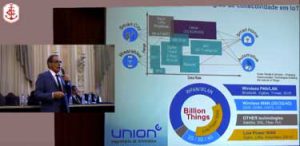
Diversity is also present in the verticals (service sectors) and domains (application groups) within the IoT ecosystem, which implies a wide variety of devices typically associated with each service/application, as well as dependence on typical usage locations.
Such information (e.g., location, device type, and applications) characterizes the necessary connectivity requirements. At first glance, this seems to require multiple technologies with specific performances and capacities—something completely unfeasible from a technical-economic standpoint.
We can, therefore, pose the first challenge: Is it really necessary to keep these domains separate with individual, specific solutions, or should we try to define common functionalities and technologies that could be made available as an integrated solution for diverse areas, services, and applications?
A positive answer to this question is imperative, as it makes no sense for any operator or connectivity provider to develop one platform for transport, another for energy, another for surveillance, and so on.
In other words, what academia and companies are currently seeking is a single platform, characterized by a set of common functionalities, that can serve several different application domains.
However, this is not the only type of diversity that has a major potential impact on IoT connectivity solutions.
Another highly important factor is the universal “softwarization” occurring across the technological landscape.
In the case of Telcos, “softwarization” will impact networks, which will become more about software than switches and hardware systems, leading to a major transformation in operators’ networks.
We are used to working at the core of the network and considering terminal devices to be very simple.
But the world has changed, and there are now more intelligent terminals capable of communicating with sensors in different ways—either through the network or directly via short-range connectivity, such as Bluetooth, Zigbee, and others.
The concept of communications is changing with IoT, with a myriad of ways for objects and services to communicate with each other.
Furthermore, there is what some specialists call the “Virtual Continuum”: today, any physical object can be represented in the cloud, making it possible to establish a connection between a physical object and its virtual representation (a “digital twin” or software object), which can then provide some type of service. In short, the ability to virtualize objects and develop services using the virtualized version emerges. Along with this come new connectivity needs, now associated with the integration of the virtual and physical worlds (the Metaverse—a collective, shared virtual space created by the convergence of virtual reality, augmented reality, and the Internet).
A general comparative overview was presented, covering wide-area technologies—Low Power Wide Area Networks (LPWANs), Wireless Neighborhood Area Networks (WNANs), Wireless Local Area Networks (WLANs), Wireless Factory Area Networks (WFANs), Wireless Home Area Networks (WHANs), Wireless Personal Area Networks (WPANs)—and proximity technologies (NFC – Near Field Communication).
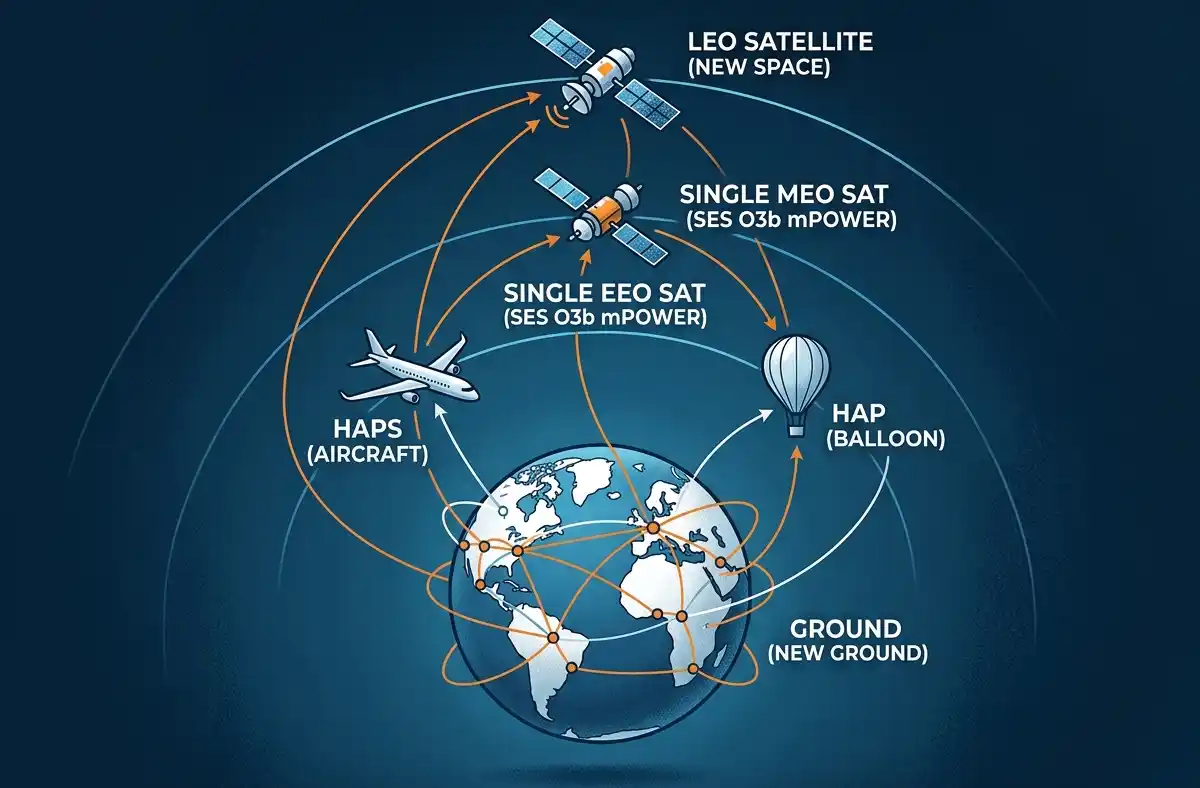
Different satellite connection options were also discussed in the presentation, including High-Throughput Satellites (HTS), operators in the Ka, Ku, and V bands, Low Earth Orbit (LEO) satellite constellations, and small satellites (cubesats, nanosats) for IoT.
Click here to watch the video of the presentation.